
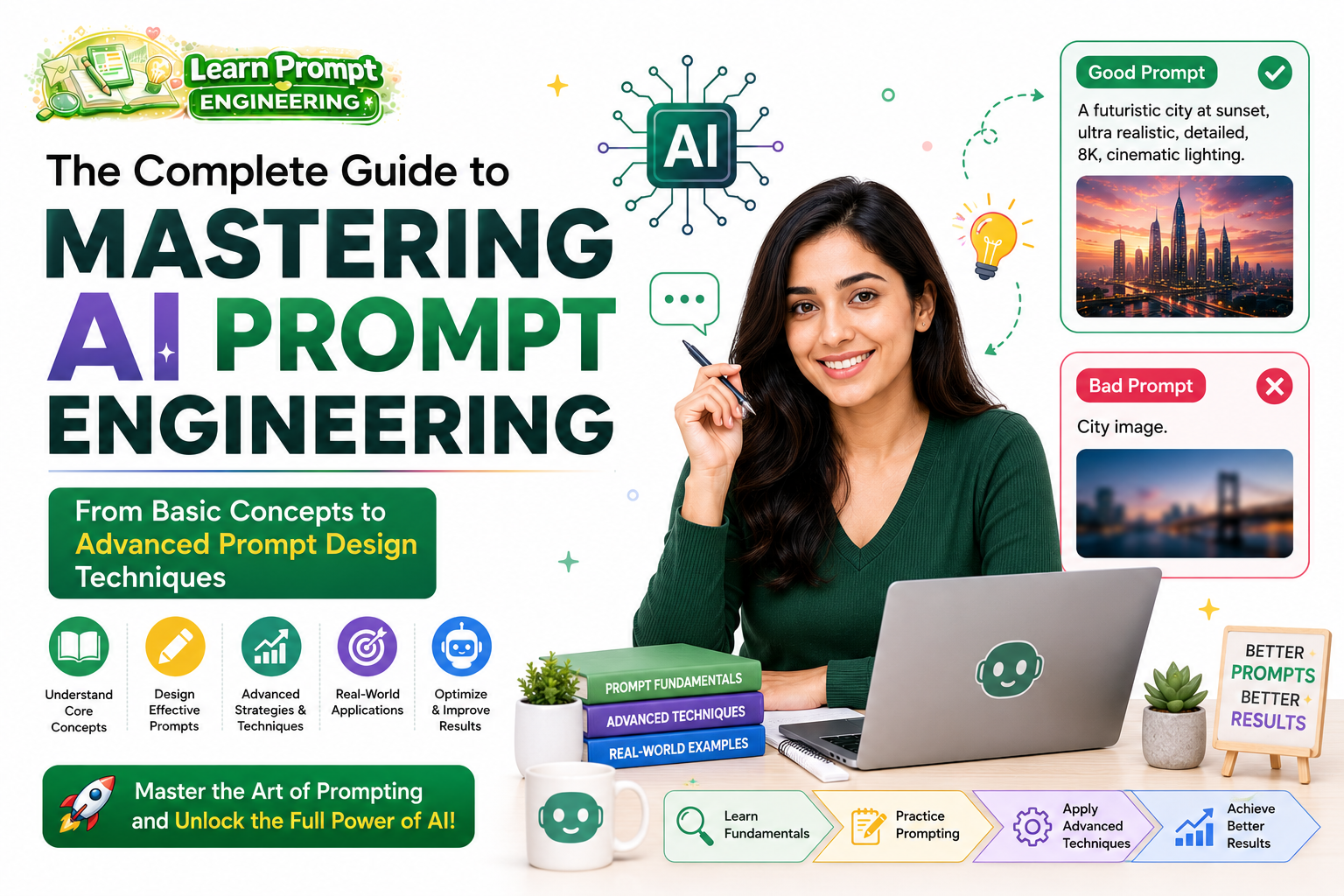
This complete guide takes you from the fundamental concepts of prompt engineering to advanced techniques used by professionals. Whether you are a beginner or looking to refine your skills, this resource provides a clear pathway to mastery.
Section 1: Basic Concepts
What is Prompt Engineering?
Prompt engineering is the practice of crafting clear, structured, and effective instructions for AI models to generate desired outputs. It is both an art and a systematic skill.
Core Principles
- Clarity: Use unambiguous language
- Specificity: Define exact requirements
- Context: Provide necessary background
- Structure: Organize instructions logically
- Iteration: Refine based on results
Section 2: Foundational Techniques
1. Role Assignment
Assign a specific persona to the AI (e.g., “Act as a senior marketing strategist…”).
2. Output Specification
Clearly define format, length, tone, and structure.
3. Context Provision
Supply relevant background information and constraints.
4. Chain of Thought Prompting
Encourage step-by-step reasoning: “Think step by step before answering.”
Section 3: Intermediate Techniques
Few-Shot Prompting
Provide examples to demonstrate desired output style and format.
Constraint Engineering
Use guardrails such as word limits, source restrictions, and style prohibitions.
Task Decomposition
Break complex requests into smaller, sequential prompts.
Section 4: Advanced Prompt Design Techniques
Prompt Chaining
Use multiple connected prompts where each output feeds into the next step.
Self-Consistency Methods
Generate multiple responses and select or synthesize the best answer.
Meta-Prompting
Ask the AI to help improve or generate better prompts.
Domain-Specific Frameworks
Develop specialized prompting strategies for writing, analysis, coding, or creative work.
Prompt Optimization Best Practices
- Test prompts across different models
- Maintain a well-organized prompt library
- Document successful patterns and variations
- Regularly review and update templates
Common Challenges and Solutions
- Hallucinations: Add factual constraints and ask for reasoning
- Inconsistency: Use few-shot examples and strict formatting
- Vague Outputs: Increase specificity and provide examples
Building Mastery
Mastery comes from consistent daily practice, systematic experimentation, and continuous refinement. Treat prompt engineering as both a technical skill and a creative practice.
Conclusion
Prompt engineering is a foundational skill in the age of artificial intelligence. By progressing from basic concepts through advanced techniques, you can achieve remarkable control over AI outputs and unlock the full potential of generative tools.
Begin with the fundamentals, practice diligently, and gradually incorporate advanced methods. Your ability to communicate effectively with AI will become one of your most valuable professional assets.
This complete guide contains approximately 980 words and provides a structured path from basic to advanced prompt engineering mastery.