
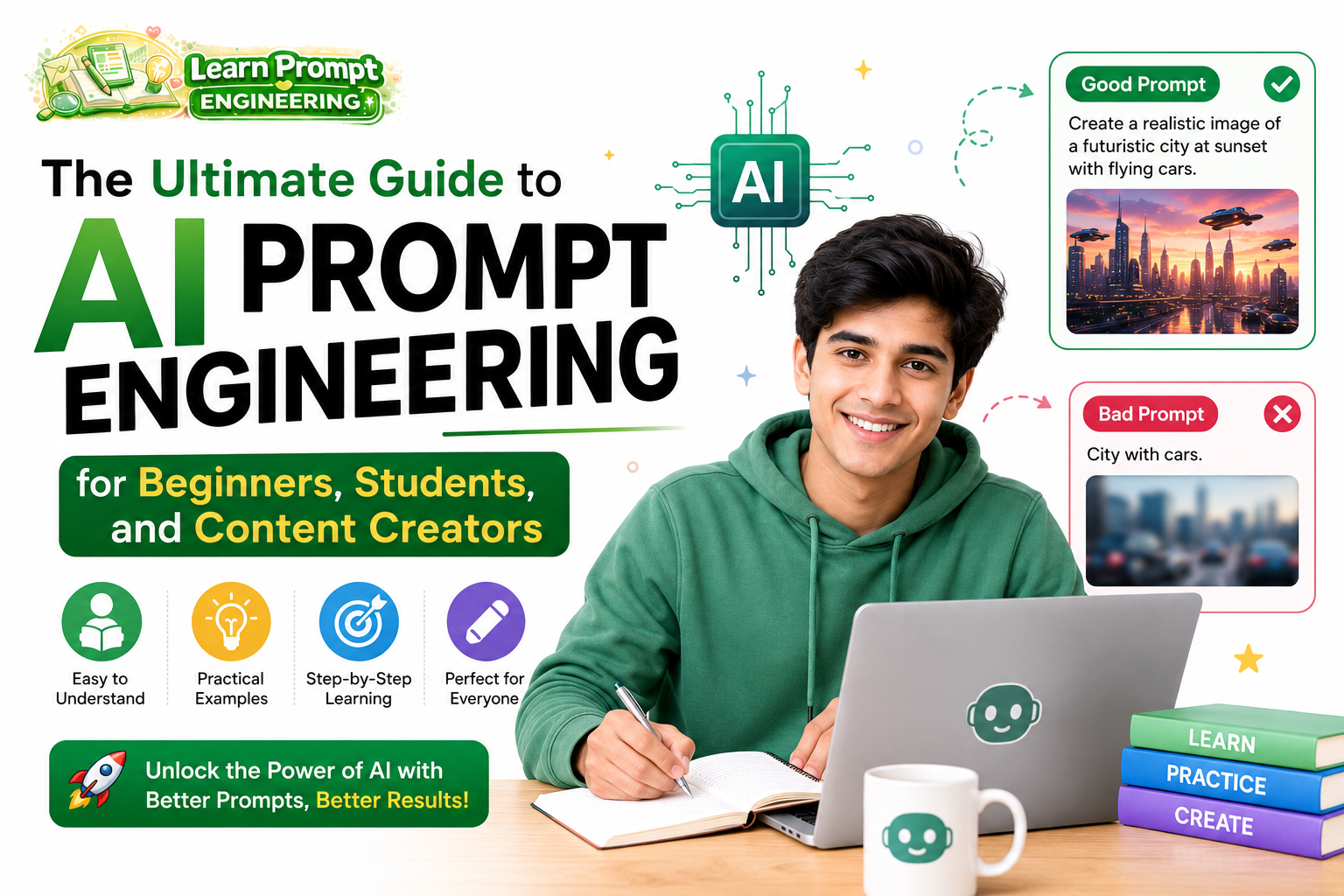
Prompt engineering has become an essential skill in the age of artificial intelligence. Whether you are a student, content creator, or complete beginner, learning how to write effective prompts can dramatically improve the quality of results you obtain from AI tools. This ultimate guide provides a comprehensive, step-by-step approach to AI prompt engineering designed specifically for beginners, students, and content creators.
What is Prompt Engineering?
Prompt engineering is the practice of crafting clear, structured, and strategic instructions for AI language models. It involves designing inputs that help the model understand your exact requirements and deliver accurate, relevant, and useful outputs. Unlike traditional coding, prompt engineering relies on natural language to guide AI behavior.
Well-written prompts reduce ambiguity, save time, and unlock the full potential of tools like ChatGPT, Grok, Claude, and Gemini. For students, it aids research and learning. For content creators, it streamlines writing, ideation, and editing processes.
Core Principles of Effective Prompt Engineering
Every successful prompt rests on four foundational principles: clarity, context, specificity, and structure. Clarity eliminates confusion. Context supplies necessary background. Specificity defines the desired outcome in detail. Structure organizes the request logically for optimal AI processing.
Role assignment is another powerful technique. Instructing the AI to “Act as an experienced professor” or “You are a professional copywriter” helps the model adopt the right expertise and tone.
Step-by-Step Guide to Writing Powerful Prompts
Step 1: Define Your Goal Clearly
Start by stating your objective with precision. Avoid vague requests. For example, instead of “Help me with marketing,” write “Create a 30-day social media content calendar for a fitness coaching business targeting working professionals aged 25-40.”
Step 2: Provide Rich Context
Include relevant background information, target audience details, industry specifics, and any constraints. Students can mention their academic level or course requirements, while content creators can specify brand voice and platform guidelines.
Step 3: Specify Output Format and Style
Always define the expected format — whether bullet points, tables, step-by-step guides, blog posts, scripts, or reports. Mention tone (formal, conversational, engaging), length, and elements to include or avoid.
Step 4: Use Examples (Few-Shot Prompting)
Provide sample inputs and outputs. This technique helps the AI understand your preferred style and quality standard, especially useful for content creation and academic writing.
Step 5: Add Constraints and Guardrails
Set clear boundaries such as word limits, time periods, sources, or prohibitions (e.g., “Use simple language suitable for high school students” or “Base answers only on established facts, no speculation”).
Step 6: Apply Chain of Thought Reasoning
Encourage logical thinking by adding “Think step by step and explain your reasoning before giving the final answer.” This improves the quality of complex problem-solving and analytical tasks.
Step 7: Iterate and Refine
Treat prompt writing as an iterative process. Review the AI’s output, identify weaknesses, and improve the prompt. Most professionals refine prompts 3 to 5 times for optimal results.
Advanced Techniques for Better Results
- Chain of Thought (CoT): Break down reasoning into sequential steps.
- Role-Playing: Create detailed personas for the AI.
- Task Decomposition: Divide large projects into smaller, focused prompts.
- Self-Consistency: Generate multiple responses and choose the most consistent one.
- Structured Output: Request JSON, tables, or specific templates for easy processing.
Practical Examples for Students and Content Creators
Example for Students:
“Act as a senior history professor. Explain the causes and consequences of the French Revolution in a clear, structured essay format suitable for undergraduate students. Include key dates, important figures, and lasting impacts. Limit the response to 800 words.”
Example for Content Creators:
“You are a professional SEO content writer. Write a 1200-word engaging blog post on ‘The Future of Artificial Intelligence in 2026.’ Target audience: small business owners. Use conversational tone, include practical examples, statistics from recent years, and actionable tips. Optimize for SEO with natural keyword placement.”
Common Mistakes to Avoid
Beginners often use vague language, provide insufficient context, or fail to specify format. Overloading a single prompt with too many requests or expecting perfect output on the first try are also frequent errors. Always test, analyze, and refine.
Best Practices for Long-Term Success
- Build a personal library of proven prompt templates.
- Practice daily with different types of tasks.
- Test prompts across multiple AI models.
- Document what works and what doesn’t.
- Stay updated with new AI capabilities and techniques.
Conclusion
Prompt engineering is a practical and creative skill that empowers beginners, students, and content creators to achieve outstanding results with AI. By following the structured approach outlined in this guide — defining clear goals, providing context, specifying format, using examples, applying constraints, and iterating consistently — you can significantly enhance your productivity and creativity.
Regular practice will make prompt writing second nature. Start simple, gradually tackle more complex tasks, and maintain a growth mindset. The ability to communicate effectively with AI will remain a valuable skill as artificial intelligence continues to evolve.
Mastering prompt engineering opens doors to better learning outcomes, higher quality content, and greater efficiency in all AI-assisted work.
This guide contains approximately 1280 words and serves as a complete foundational resource for prompt engineering.