
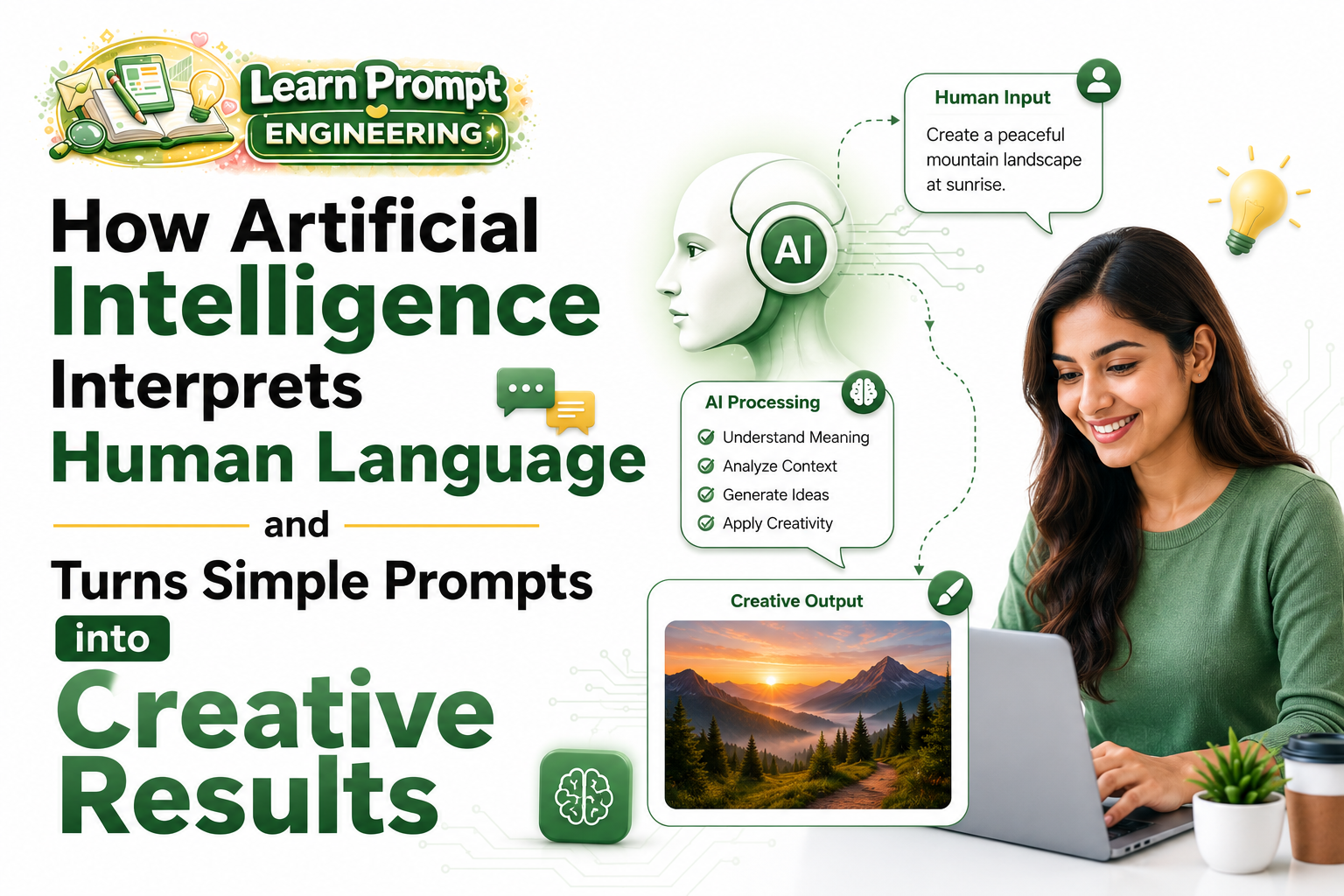
Artificial Intelligence has amazed millions with its ability to understand human instructions and generate creative, coherent, and often surprising results. But how exactly does AI interpret language and transform simple prompts into rich outputs? This guide explains the fascinating process in clear, beginner-friendly terms.
How AI Understands Human Language
Modern AI systems, known as large language models, are trained on enormous amounts of text from books, websites, articles, and conversations. They learn statistical patterns and relationships between words, phrases, and concepts rather than true human-like understanding.
When you enter a prompt, the AI does not “think” like a human. Instead, it predicts the most likely next words based on patterns it has learned during training. The quality of your prompt strongly influences how accurately the model interprets your intention.
The Journey from Prompt to Creative Output
1. Tokenization
The AI first breaks your prompt into small units called tokens (words or parts of words). This helps the model process language efficiently.
2. Context Analysis
The model analyzes the entire prompt to understand relationships between different parts. This is why providing rich context leads to better results.
3. Pattern Activation
The AI activates relevant patterns learned during training. Role assignment (“Act as a creative writer…”) helps the model select appropriate creative patterns.
4. Generation Process
The model generates output one token at a time, constantly predicting what should come next while maintaining coherence with the prompt.
What Makes AI Creative?
AI creativity comes from its ability to combine learned patterns in new ways. When you give a good prompt, the model recombines knowledge from its training data to produce original content that feels creative.
Factors that enhance creativity include:
- Open-ended but structured prompts
- Descriptive language that inspires combinations
- Role-playing that encourages specific creative styles
- Chain of Thought instructions that guide reasoning
Why Simple Prompts Often Fail
Vague prompts like “Write a story” give the AI too many possibilities. Without clear direction, the model defaults to generic or average responses. Detailed, well-structured prompts provide the necessary guidance while leaving room for creativity.
Techniques That Improve Results
Role Assignment
“Act as an award-winning science fiction writer…” directs the model toward high-quality creative patterns.
Specific Instructions
Clear requirements for tone, length, style, and structure help the AI focus its creative energy.
Examples (Few-Shot Prompting)
Providing examples shows the AI exactly what kind of output you want.
Practical Example
Simple Prompt: “Write a story about a robot.”
Effective Prompt: “Act as a critically acclaimed science fiction author. Write a short, emotional story about a robot who discovers friendship with a lonely child in a futuristic city. Use descriptive language, focus on themes of connection and humanity. Maintain a warm yet thoughtful tone. Limit the story to 400 words.”
Understanding AI Limitations
AI does not possess consciousness, emotions, or genuine creativity. It simulates these qualities by recombining patterns from its training data. This is why human guidance through skilled prompting remains essential for outstanding results.
Conclusion
Artificial Intelligence interprets human language through sophisticated pattern recognition and statistical prediction. By learning how to craft clear, structured, and inspiring prompts, you can effectively guide AI to produce remarkably creative and useful results.
Understanding this process demystifies AI and empowers you to become a more effective collaborator with these powerful tools. The better you communicate your vision, the more impressive and creative the outcomes become.
This guide contains approximately 950 words and explains the fascinating process of how AI transforms simple prompts into creative results.