
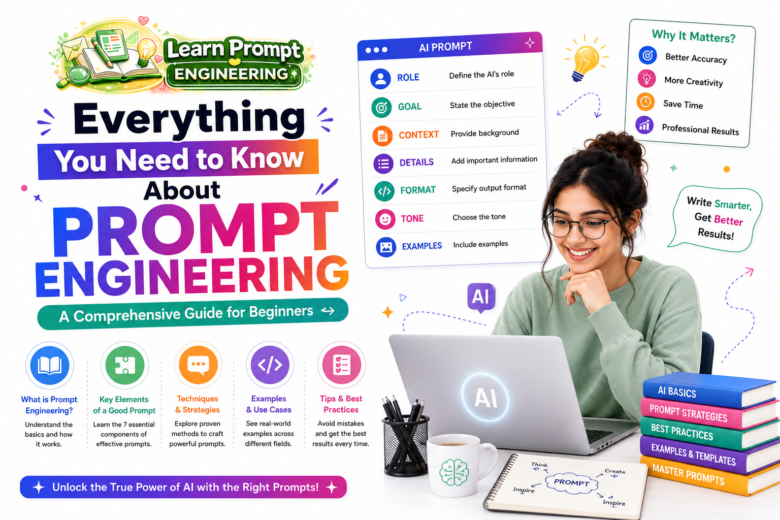
Prompt engineering is the art and science of crafting effective instructions for artificial intelligence models. As AI tools become increasingly integrated into professional and creative workflows, the ability to write high-quality prompts has emerged as a valuable skill. This comprehensive guide provides beginners with everything they need to know about prompt engineering, from fundamental concepts to advanced techniques.
Understanding Prompt Engineering
Prompt engineering refers to the systematic process of designing inputs that guide AI language models to produce accurate, relevant, and useful outputs. Unlike traditional programming, where code dictates exact behavior, large language models respond based on patterns learned during training. A well-crafted prompt acts as a bridge between user intent and model capabilities.
The quality of a prompt directly influences the output. Poor prompts often result in vague, incorrect, or irrelevant responses, while effective prompts yield precise and actionable results. Mastering this skill can dramatically improve productivity across writing, analysis, coding, research, and creative tasks.
Core Principles of Effective Prompts
Successful prompts generally incorporate four essential elements: clarity, context, specificity, and structure. Clarity ensures the AI understands the request without ambiguity. Context provides necessary background information. Specificity defines exact requirements regarding format, length, tone, and depth. Structure organizes instructions logically for better processing by the model.
Additionally, role-playing is highly effective. Assigning a specific persona to the AI — such as “Act as a senior marketing strategist” or “You are an expert Python developer” — helps the model adopt the appropriate knowledge base and tone.
Step-by-Step Guide to Writing Better Prompts
Step 1: Clearly Define Your Objective
Begin by articulating exactly what you want to achieve. Vague goals lead to vague outputs. Instead of asking “Explain machine learning,” specify: “Explain the fundamental differences between supervised, unsupervised, and reinforcement learning with real-world business applications.”
Step 2: Provide Rich Context
Supply relevant background information, constraints, and target audience details. For professional work, mention industry, audience expertise level, and any specific frameworks or methodologies to follow.
Step 3: Specify Output Format and Requirements
Always define the desired format. Request structured responses such as bullet points, numbered lists, tables, executive summaries, or detailed reports. Indicate word count, tone (formal, conversational, technical), and any elements to include or exclude.
Step 4: Utilize Few-Shot Learning
Provide one or more examples of desired input-output pairs. This technique, known as few-shot prompting, significantly improves consistency and quality, especially for tasks involving classification, formatting, or creative writing.
Step 5: Add Constraints and Guardrails
Limit scope using clear boundaries. Examples include “Base your answer only on information from 2023 onward,” “Avoid technical jargon,” “Limit response to 500 words,” or “Do not speculate; rely on established facts.”
Step 6: Implement Chain of Thought Reasoning
Encourage the AI to think step by step. Adding the phrase “Think step by step and explain your reasoning before giving the final answer” often leads to more logical and transparent outputs.
Step 7: Iterate and Refine
Treat prompt writing as an iterative process. Analyze the first output, identify shortcomings, and refine the prompt accordingly. This cycle of testing and improvement is central to professional prompt engineering.
Advanced Prompting Techniques
Beyond basic methods, several advanced techniques can further enhance results:
- Chain of Thought (CoT): Breaks down complex reasoning into sequential steps.
- Tree of Thoughts: Explores multiple reasoning paths before selecting the best solution.
- Self-Consistency: Generate multiple responses and select the most consistent answer.
- Role-Playing Scenarios: Create detailed character profiles for the AI.
- Task Decomposition: Break large projects into smaller, manageable prompts.
Practical Examples
Example 1: Content Creation
Basic Prompt: “Write a blog post about AI.”
Improved Prompt: “Act as a professional technology writer with 10 years of experience. Write a 1200-word SEO-optimized blog post titled ‘How Artificial Intelligence is Transforming Modern Business Operations.’ Target audience: small business owners. Include real-world examples, statistics from 2024-2025, and practical implementation steps. Use engaging subheadings and conclude with actionable recommendations.”
Example 2: Problem Solving
“You are an expert business consultant. A retail company is experiencing declining sales. Analyze possible causes and provide a detailed 6-month recovery strategy. Think step by step and present the solution in a structured business report format with clear sections.”
Common Mistakes and How to Avoid Them
Many beginners overload prompts with excessive information, use ambiguous language, or fail to specify format requirements. Others assume the AI has current knowledge without providing necessary updates. Always review outputs critically and refine prompts accordingly.
Another frequent error is expecting perfect results from the first attempt. Professional prompt engineers typically iterate 3-5 times before achieving optimal outputs.
Best Practices for Professional Use
- Maintain a personal library of effective prompt templates.
- Test prompts across different AI models to understand their strengths.
- Document successful prompts with notes on when and why they worked.
- Combine multiple techniques rather than relying on a single method.
- Stay updated with evolving AI capabilities and best practices.
Conclusion
Prompt engineering is both an essential skill and a creative practice. By following the systematic approach outlined in this guide — defining clear objectives, providing context, specifying format, using examples, adding constraints, and iterating consistently — beginners can rapidly improve their ability to harness the full potential of AI tools.
With regular practice, prompt writing becomes intuitive and highly effective. Whether you are a student, professional, entrepreneur, or creative, investing time in developing this skill will provide significant returns in productivity and output quality.
The field continues to evolve rapidly. Those who master prompt engineering today will be well-positioned to leverage future advancements in artificial intelligence.
This guide contains approximately 1250 words and is designed to provide practical, actionable knowledge for beginners in prompt engineering.