
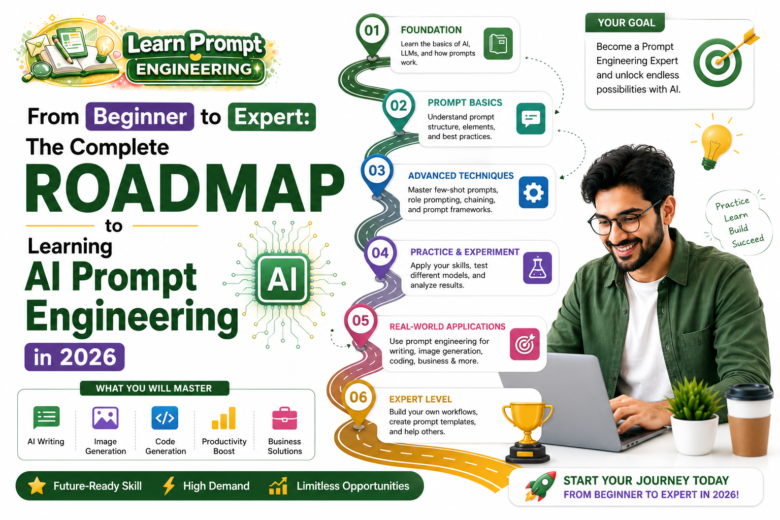
Artificial intelligence is transforming how we work, learn, and create. At the heart of this transformation lies prompt engineering — the skill of communicating effectively with AI models. This complete roadmap takes you from complete beginner to expert level in AI prompt engineering in 2026. Whether you are a student, professional, or content creator, this structured guide will help you build strong foundations and advance systematically.
Phase 1: Beginner Level – Understanding the Basics
Start by learning what prompt engineering is and why it matters. Prompt engineering is the practice of designing clear, precise instructions that guide AI models to produce high-quality outputs. Unlike traditional programming, it uses natural language to direct AI behavior.
Focus on the four core principles: clarity, context, specificity, and structure. Practice writing simple prompts and observe how small changes affect the AI’s responses. Begin with basic tasks such as summarization, explanation, and idea generation.
Phase 2: Foundational Techniques
Master essential techniques that form the backbone of effective prompting:
- Role Assignment: Instruct the AI to adopt a specific persona (e.g., “Act as an experienced data scientist”).
- Chain of Thought Prompting: Add “Think step by step” to encourage logical reasoning.
- Few-Shot Prompting: Provide examples of desired input and output.
- Output Formatting: Specify exact structure, tone, length, and style.
At this stage, practice daily with real tasks relevant to your field — academic writing for students or content creation for creators.
Phase 3: Intermediate Level – Developing Precision and Control
Move beyond basics by incorporating constraints and guardrails. Learn to limit scope, define word count, restrict sources, and prevent unwanted behaviors. Develop the habit of iteration — treating the first response as a draft and refining the prompt based on results.
Learn task decomposition: break complex projects into smaller, focused prompts. For content creators, this means separating research, outlining, drafting, and editing phases.
Phase 4: Advanced Techniques
Explore sophisticated methods used by professionals in 2026:
- Tree of Thoughts: Explore multiple reasoning paths before selecting the best solution.
- Self-Consistency: Generate several responses and choose the most consistent answer.
- Multi-Step Reasoning: Create prompt chains where the output of one prompt becomes input for the next.
- Domain-Specific Prompting: Tailor prompts for coding, legal analysis, creative writing, or scientific research.
Experiment with different AI models to understand their unique strengths and limitations.
Phase 5: Expert Level – Mastery and Innovation
At the expert stage, focus on building reusable prompt frameworks and templates. Develop custom prompting strategies for your specific domain. Learn to combine multiple advanced techniques and integrate AI tools into complete workflows.
Experts also stay updated with rapidly evolving AI capabilities and contribute to the community by sharing effective prompts and methodologies. Build a personal prompt library organized by use case and effectiveness.
Practical Roadmap: 30-Day Learning Plan
Week 1: Master basic principles and write 10 simple prompts daily.
Week 2: Practice role assignment, chain of thought, and few-shot techniques.
Week 3: Work on intermediate skills — iteration, constraints, and task decomposition.
Week 4: Explore advanced techniques and build your first complete AI-assisted project.
Real-World Examples Across Levels
Beginner Example: “Explain photosynthesis in simple terms.”
Intermediate Example: “Act as a biology teacher. Explain photosynthesis step by step for high school students, including chemical equations and real-world importance. Limit to 400 words.”
Advanced Example: “You are a senior scientific educator. Create a detailed lesson plan on photosynthesis for undergraduate students. Include learning objectives, key concepts, diagrams description, assessment questions, and common misconceptions. Structure in clear sections and think step by step.”
Common Pitfalls and How to Overcome Them
Avoid vague language, insufficient context, and expecting perfection on the first try. Overloading prompts and neglecting iteration are major obstacles. Develop a critical eye for analyzing AI outputs and continuously refine your approach.
Best Practices for 2026 and Beyond
- Maintain a well-organized prompt library.
- Test prompts across multiple AI models.
- Document successful strategies and lessons learned.
- Practice consistently and apply skills to real projects.
- Stay informed about new AI developments and techniques.
Conclusion
This roadmap provides a clear path from beginner to expert in AI prompt engineering in 2026. Success depends on consistent practice, systematic learning, and continuous refinement. By following the phases and techniques outlined here, you can develop a highly valuable skill that enhances learning, creativity, and productivity.
Begin today with simple prompts and gradually increase complexity. The journey from beginner to expert is achievable with dedication and the right approach. Prompt engineering is not just a technical skill — it is a powerful way to amplify human intelligence in the AI era.
This comprehensive roadmap contains approximately 1320 words and is designed as a practical guide for learners in 2026.