
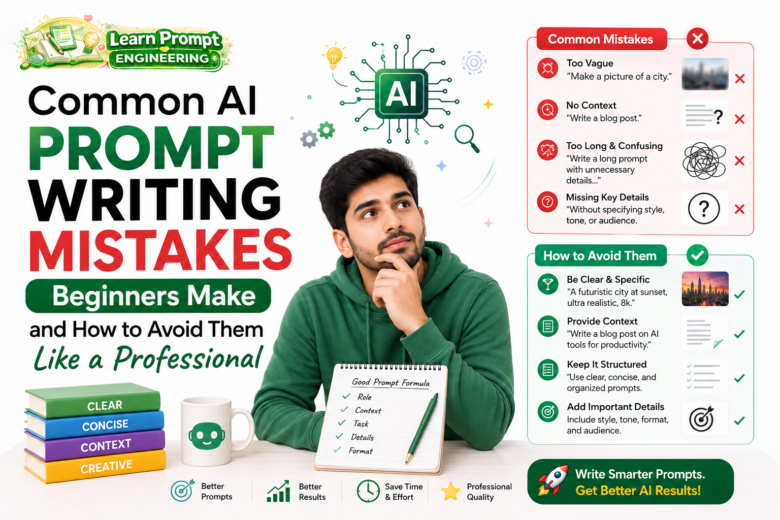
Many beginners struggle to get high-quality results from AI tools despite their potential. The primary reason is often not the AI itself, but how prompts are written. This comprehensive guide identifies the most common AI prompt writing mistakes beginners make and provides professional strategies to avoid them effectively.
Why Prompt Quality Matters
The difference between mediocre and exceptional AI outputs usually comes down to prompt engineering. Understanding frequent errors allows users to communicate more effectively with AI models and achieve reliable, professional-grade results.
Top 10 Common AI Prompt Writing Mistakes and How to Avoid Them
Mistake 1: Using Vague or Ambiguous Language
Beginners often write prompts like “Tell me about marketing” or “Explain AI.”
Professional Solution: Be specific and precise. Instead, write: “Explain the core components of digital marketing strategy for small e-commerce businesses in 2026, including SEO, social media, and email marketing.”
Mistake 2: Failing to Provide Context
AI models lack personal memory and real-time awareness. Omitting context leads to generic or irrelevant responses.
Professional Solution: Always include background information, target audience, industry details, and constraints. For example, specify academic level for students or brand voice for content creators.
Mistake 3: Not Specifying Desired Output Format
Leaving format open results in inconsistent or difficult-to-use outputs.
Professional Solution: Explicitly define structure: “Respond in a structured report with Executive Summary, Key Findings, and Actionable Recommendations sections. Use bullet points and limit to 600 words.”
Mistake 4: Overloading a Single Prompt
Asking multiple complex questions in one prompt overwhelms the model.
Professional Solution: Break complex tasks into smaller, focused prompts. Use prompt chaining where the output of one prompt feeds into the next.
Mistake 5: Expecting Perfect Results on the First Try
Many beginners accept the first response without refinement.
Professional Solution: Treat prompting as an iterative process. Review outputs critically and refine prompts 2–4 times for optimal quality.
Mistake 6: Ignoring Role Assignment
Generic prompts fail to leverage the AI’s ability to adopt expert perspectives.
Professional Solution: Use strong role assignments such as “Act as a senior financial analyst with 15 years of experience” or “You are an expert academic writing coach.”
Mistake 7: Using Unclear or Subjective Terms
Words like “good,” “best,” “interesting,” or “detailed” are interpreted differently by the model.
Professional Solution: Replace subjective terms with measurable criteria. For example, specify word count, depth level, or exact requirements.
Mistake 8: Not Using Chain of Thought Prompting
Complex problems often receive shallow answers without reasoning instructions.
Professional Solution: Add “Think step by step and explain your reasoning before giving the final answer” for analytical or problem-solving tasks.
Mistake 9: Forgetting Constraints and Guardrails
Without boundaries, responses can become too broad, outdated, or inappropriate.
Professional Solution: Include clear limitations such as “Use only information from 2024–2026,” “Avoid technical jargon,” or “Do not include speculative content.”
Mistake 10: Lack of Examples (Zero-Shot vs Few-Shot)
Many beginners rely solely on instructions without demonstrating desired style.
Professional Solution: Provide 1–3 examples of input-output pairs (Few-Shot Prompting) to guide tone, structure, and quality.
Additional Professional Best Practices
- Build and maintain a personal library of proven prompt templates.
- Test prompts across different AI models to understand their strengths.
- Document successful prompts with notes on when and why they worked.
- Review outputs for accuracy, relevance, and usefulness before final use.
- Stay updated with evolving AI capabilities and prompting techniques.
Real-World Example: Before and After
Beginner Prompt: “Write a blog post about productivity.”
Professional Prompt: “Act as a productivity coach with expertise in behavioral psychology. Write a 1000-word SEO-optimized blog post titled ‘Proven Strategies to Boost Daily Productivity in 2026.’ Target audience: working professionals. Include practical examples, scientific references, and a step-by-step 30-day plan. Use engaging subheadings and a conversational yet professional tone.”
Conclusion
Avoiding common prompt writing mistakes requires awareness, practice, and systematic refinement. By applying the professional strategies outlined in this guide, beginners can rapidly improve their results and approach prompt engineering with confidence.
Consistent application of these principles transforms AI from an unpredictable tool into a reliable professional assistant. Start reviewing your current prompts today, implement the corrections, and observe the significant improvement in output quality.
This guide contains approximately 1220 words and is designed to help beginners overcome common challenges and develop professional-level prompt engineering skills.