
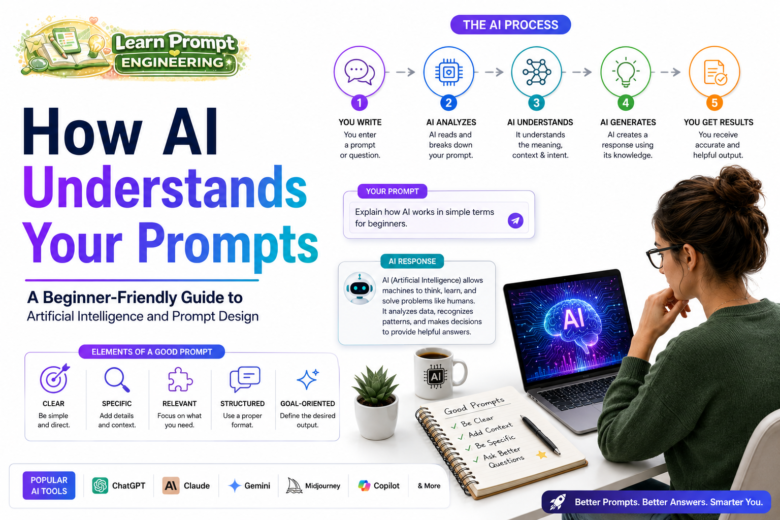
Artificial intelligence tools have become powerful assistants in writing, learning, research, and content creation. However, many users remain unsure about how these systems actually interpret and respond to their instructions. This beginner-friendly guide explains how AI understands prompts and teaches practical prompt design techniques that deliver better results.
How AI Models Process and Understand Prompts
Large language models powering modern AI systems are trained on vast collections of text from books, websites, articles, and conversations. They learn statistical relationships between words, phrases, and concepts rather than true human-like understanding.
When you submit a prompt, the AI breaks it down into tokens (small pieces of text) and analyzes patterns to predict the most appropriate response. The quality of your prompt directly influences how accurately the model interprets your intent.
Why Prompt Design Matters
Even the most advanced AI can produce poor results with unclear instructions. Well-designed prompts reduce ambiguity, minimize errors, and help the AI align its output with your specific needs. This is especially valuable for students, content creators, and professionals seeking reliable AI assistance.
Key Mechanisms AI Uses to Understand Prompts
- Context Analysis: The model considers the entire prompt as context to generate relevant responses.
- Pattern Recognition: It draws upon similar patterns learned during training.
- Role Interpretation: Explicit role assignments help the model select appropriate knowledge and tone.
- Instruction Following: Clear commands and formatting instructions guide the output structure.
Step-by-Step Guide to Better Prompt Design
Step 1: Clarify Your Goal
Start with a precise objective. Define exactly what you want the AI to accomplish before writing the full prompt.
Step 2: Provide Sufficient Context
Include background information, target audience, constraints, and relevant details. AI models do not remember previous conversations unless explicitly provided with context.
Step 3: Assign a Clear Role
Use phrases like “Act as a professional editor,” “You are an expert history teacher,” or “Behave as a senior marketing consultant.” Role assignment improves relevance and quality.
Step 4: Specify Output Requirements
Clearly state the desired format, length, tone, and style. Examples: “Respond in bullet points,” “Write in a formal tone,” or “Limit the answer to 400 words.”
Step 5: Add Reasoning Instructions
For analytical tasks, include “Think step by step” or “Explain your reasoning before giving the final answer.” This technique often yields more thoughtful responses.
Step 6: Test, Evaluate, and Refine
Review the AI’s output and adjust your prompt accordingly. Iteration is one of the most important skills in prompt design.
Practical Examples
Basic Prompt (Less Effective):
“Tell me about marketing.”
Improved Prompt:
“Act as a professional digital marketing strategist with 10 years of experience. Explain the key components of a successful social media marketing strategy for small businesses in 2026. Include practical examples, current trends, and a step-by-step implementation plan. Use clear headings and keep the response under 700 words.”
Common Challenges and Solutions
AI may sometimes generate inaccurate information (hallucinations). Counter this by adding constraints like “Base your answer only on verified facts” and always verify critical information. Inconsistent outputs can be improved by providing examples and detailed formatting instructions.
Best Practices for Beginners
- Use simple and direct language.
- Break complex requests into smaller parts.
- Provide examples of desired output style.
- Be specific about what should be included or avoided.
- Practice regularly with different types of tasks.
Conclusion
Understanding how AI interprets prompts removes much of the mystery surrounding these tools and enables more effective use. By applying the principles and step-by-step methods in this guide, beginners can quickly improve their ability to communicate with AI systems.
Mastering prompt design is a practical skill that enhances learning, creativity, and productivity. Start experimenting with the techniques today, remain consistent in your practice, and you will see significant improvements in the quality of AI-generated results.
This beginner-friendly guide contains approximately 1150 words and focuses on both the inner workings of AI and practical prompt design strategies.