
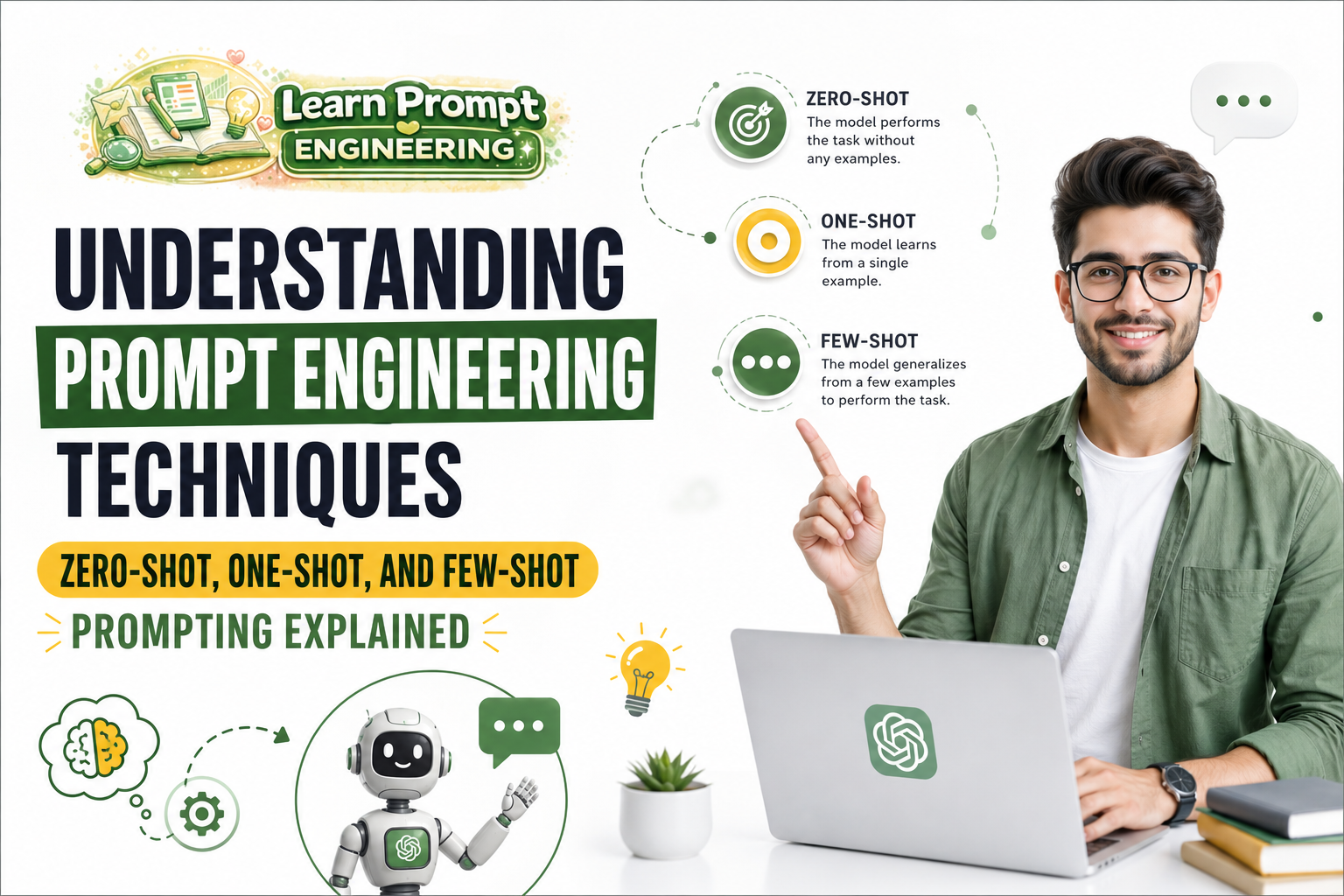
Prompt engineering has become a critical skill for maximizing the potential of large language models. Among the most important techniques are Zero-Shot, One-Shot, and Few-Shot prompting. This guide provides a clear explanation of each method, their differences, and practical applications.
What is Prompt Engineering?
Prompt engineering is the practice of designing effective inputs to guide AI models toward producing desired outputs. Different prompting strategies offer varying levels of guidance to the model.
Zero-Shot Prompting
Zero-shot prompting involves giving the AI a task without any examples. The model relies entirely on its pre-trained knowledge to complete the request.
When to Use Zero-Shot Prompting
Use this method for simple, straightforward tasks where the model already has strong general knowledge.
Example:
Prompt: “Translate the following sentence to French: Hello, how are you today?”
Expected Output: The model directly translates without needing examples.
Advantages and Limitations
Advantages: Simple, fast, and requires minimal effort.
Limitations: Less control over output style and format for complex tasks.
One-Shot Prompting
One-shot prompting provides the AI with a single example of the desired input-output pair before asking it to perform the same task on new input.
When to Use One-Shot Prompting
This technique is useful when you want the model to follow a specific format, style, or approach.
Example:
Prompt: “Classify the sentiment of the following reviews as Positive, Negative, or Neutral.
Review: The product exceeded my expectations. → Positive
Review: The customer service was very slow.”
Advantages and Limitations
Advantages: Better control over output format and style.
Limitations: May still struggle with highly specialized or complex tasks.
Few-Shot Prompting
Few-shot prompting provides the model with multiple (usually 2 to 5) examples before presenting the actual task. This technique significantly improves performance on complex or nuanced tasks.
When to Use Few-Shot Prompting
Use few-shot when high consistency, specific formatting, or complex reasoning is required.
Example:
Prompt: “Extract the key points from the following articles in bullet form.
Article 1: [text] → Key points: • Point A • Point B
Article 2: [text] → Key points: • Point X • Point Y
Article 3: [new text]”
Advantages and Limitations
Advantages: Excellent control, higher accuracy, and better adaptation to specific tasks.
Limitations: Uses more tokens, which can increase cost and response time.
Comparison Table
| Technique | Examples Provided | Best For | Control Level |
|---|---|---|---|
| Zero-Shot | None | Simple tasks | Low |
| One-Shot | One | Basic formatting | Medium |
| Few-Shot | 2–5 | Complex tasks | High |
Best Practices and Advanced Tips
- Choose the number of examples based on task complexity.
- Ensure examples are high-quality and representative.
- Keep examples consistent in format and style.
- Combine techniques with role assignment and Chain of Thought for better results.
- Test different numbers of shots to find the optimal balance.
When to Choose Which Technique
Use Zero-Shot for quick, general tasks. Choose One-Shot when format consistency is important. Opt for Few-Shot when you need high precision or the task involves specialized patterns.
Conclusion
Understanding Zero-Shot, One-Shot, and Few-Shot prompting techniques empowers you to communicate more effectively with AI models. By selecting the appropriate method for each task, you can achieve significantly better accuracy, consistency, and quality in AI-generated outputs.
Mastering these fundamental techniques forms the foundation for advanced prompt engineering and helps unlock the full potential of modern AI systems.
This guide contains approximately 980 words and provides a clear explanation of key prompting techniques.