
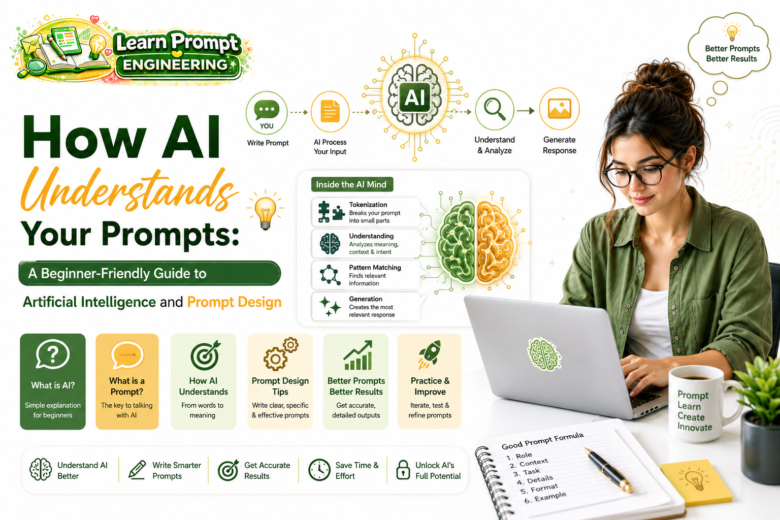
Artificial Intelligence has become part of daily life, yet many users wonder how these systems actually understand and respond to their instructions. This beginner-friendly guide explains how AI processes prompts and provides practical advice on designing better prompts for optimal results.
How AI Models Process Language
Modern AI systems, particularly large language models (LLMs), are trained on massive amounts of text data. They learn statistical patterns of how words and sentences relate to each other. When you enter a prompt, the model predicts the most likely next words based on patterns learned during training.
Unlike human understanding based on consciousness and real-world experience, AI comprehension is pattern-based. This is why clear structure and context in prompts significantly improve output quality.
The Mechanics Behind Prompt Understanding
When an AI receives a prompt, it breaks down the text into tokens (small units of language). It then analyzes relationships between these tokens using complex mathematical models called neural networks. The model considers context from the entire prompt to generate a coherent response.
Factors that influence how well AI understands a prompt include:
- Clarity of language
- Amount of relevant context
- Specificity of instructions
- Structure and formatting
Key Elements That Help AI Understand Your Intent
1. Clarity and Precision
AI performs better with direct, unambiguous language. Vague prompts lead to vague or off-target responses. Instead of saying “Tell me about history,” write “Summarize the main causes of World War II in 300 words.”
2. Providing Context
AI models do not have real-time knowledge or personal memory. Supplying relevant background information helps the model align its response with your needs. For students or content creators, include audience level, tone preferences, and specific requirements.
3. Role Assignment
One of the most effective techniques is telling the AI to adopt a specific role. Phrases such as “Act as an expert physics teacher” or “You are a professional marketing strategist” guide the model to draw upon relevant patterns in its training data.
4. Structure and Formatting Instructions
Explicitly stating the desired output format helps the AI organize its response. Requesting bullet points, numbered steps, tables, or specific sections leads to more usable results.
Step-by-Step Prompt Design Process
Step 1: Define Your Objective
Clearly state what you want to achieve before writing the prompt.
Step 2: Add Necessary Context
Include background details, constraints, and audience information.
Step 3: Use Role Assignment
Assign an expert persona relevant to the task.
Step 4: Specify Output Requirements
Define format, length, tone, and style.
Step 5: Include Reasoning Instructions
Use “Think step by step” for complex tasks.
Step 6: Test and Refine
Review results and improve the prompt iteratively.
Practical Examples
Weak Prompt:
“Write something about climate change.”
Strong Prompt:
“Act as an environmental science educator for college students. Explain the primary causes and current impacts of climate change. Include key scientific evidence and three practical individual actions. Structure the response with clear headings and limit to 600 words. Think step by step.”
Common Challenges and Solutions
AI may sometimes “hallucinate” or generate incorrect information. To reduce this risk, provide clear constraints and ask the model to base answers on established knowledge. For content creators and students, always verify important facts.
Another challenge is inconsistent outputs. Using detailed prompts with examples and specific formatting instructions helps maintain consistency.
Best Practices for Better AI Understanding
- Use simple, direct sentences when possible.
- Break complex requests into multiple steps.
- Provide examples of desired output style.
- Be specific about what to avoid in the response.
- Iterate on prompts rather than accepting the first output.
Advanced Tips for 2026
As AI models continue to evolve, experiment with multi-turn conversations, prompt chaining, and structured output formats such as JSON. Stay curious and test new techniques regularly.
Conclusion
Understanding how AI processes prompts demystifies these powerful tools and empowers you to use them more effectively. By applying the principles and techniques in this guide, beginners, students, and content creators can achieve significantly better results from AI systems.
Effective prompt design is a learnable skill that improves with practice. Start with simple tasks, gradually increase complexity, and maintain a mindset of continuous improvement. The better you communicate with AI, the more value you will extract from these remarkable technologies.
This beginner-friendly guide contains approximately 1180 words and focuses on both the mechanics of AI understanding and practical prompt design strategies.