
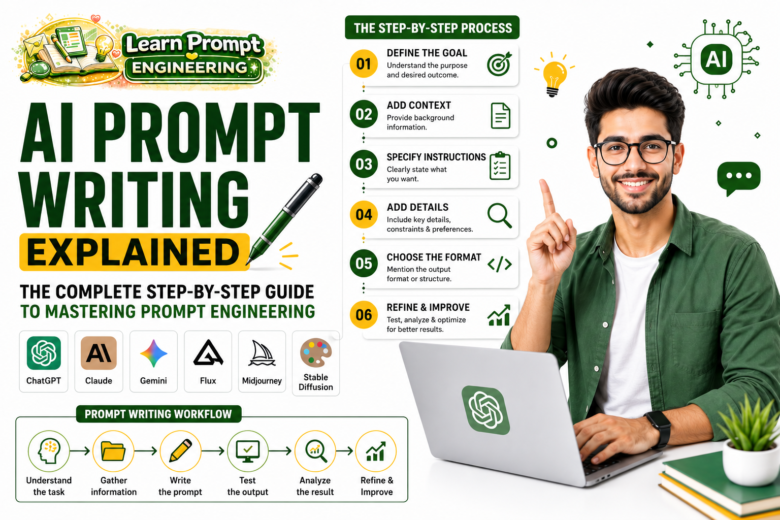
Prompt engineering is the systematic process of designing effective instructions for artificial intelligence models. This complete step-by-step guide explains AI prompt writing in detail and provides a clear pathway to mastering the skill in a structured manner.
What is Prompt Engineering?
Prompt engineering involves crafting precise inputs that guide AI language models to generate accurate, relevant, and useful outputs. It bridges human intent and machine interpretation. As AI tools become essential across industries, the ability to write effective prompts has become a highly valuable competency for professionals, students, and content creators alike.
Core Principles of AI Prompt Writing
Effective prompts are built on four fundamental principles: clarity, context, specificity, and structure. Clarity eliminates ambiguity. Context supplies necessary background. Specificity defines exact requirements. Structure organizes instructions for better processing by the AI model.
The Complete Step-by-Step Guide to Mastering Prompt Engineering
Step 1: Define Your Objective Clearly
Begin every prompt by stating your goal with precision. Vague objectives produce vague results. Instead of “Write about business,” specify “Develop a comprehensive marketing strategy for a new sustainable fashion brand targeting millennials.”
Step 2: Provide Rich Context
Supply relevant background information, audience details, constraints, and any important parameters. AI models do not possess real-time knowledge or personal memory, so explicit context is essential for accurate responses.
Step 3: Assign an Expert Role
Instruct the AI to adopt a specific persona. Role assignment helps the model access relevant knowledge patterns. Examples include “Act as a senior management consultant” or “You are an experienced academic researcher.”
Step 4: Specify Desired Output Format
Clearly define the structure, length, tone, and style of the response. Request formats such as bullet points, tables, step-by-step guides, reports, or articles. Mention word count and any required sections.
Step 5: Incorporate Examples (Few-Shot Prompting)
Provide one or more examples of input and expected output. This technique significantly improves consistency and helps the AI understand your preferred style and quality standards.
Step 6: Add Constraints and Guardrails
Set clear boundaries to maintain focus. Use instructions such as “Limit response to 500 words,” “Base answers only on facts from 2024-2026,” or “Avoid technical jargon and explain in simple terms.”
Step 7: Encourage Step-by-Step Reasoning
For complex tasks, include “Think step by step and explain your reasoning before providing the final answer.” This Chain of Thought approach often leads to more logical and transparent outputs.
Step 8: Iterate and Refine
Review the AI’s response critically. Identify weaknesses and improve the prompt accordingly. Professional prompt engineers typically refine their prompts multiple times to achieve optimal results.
Advanced Prompt Engineering Techniques
- Chain of Thought (CoT): Break down complex problems into sequential reasoning steps.
- Task Decomposition: Divide large projects into smaller, manageable prompts.
- Prompt Chaining: Use the output of one prompt as input for the next.
- Self-Consistency: Generate multiple responses and select the most consistent answer.
- Domain-Specific Frameworks: Develop specialized prompting strategies for writing, coding, analysis, or research.
Practical Examples
Beginner Level Example:
“Explain the basics of artificial intelligence.”
Advanced Level Example:
“Act as a leading AI ethics professor. Provide a detailed analysis of the ethical challenges in large language models, including bias, privacy, and misinformation. Structure the response with introduction, key issues, case studies, and recommendations. Target audience: university students. Limit to 900 words. Think step by step.”
Common Mistakes and How to Avoid Them
Beginners often use vague language, overload prompts, or fail to specify format and constraints. Avoid assuming the AI has current knowledge without providing it. Always verify critical information and maintain an iterative approach.
Best Practices for Continuous Improvement
- Maintain a personal library of effective prompt templates.
- Practice consistently with diverse tasks.
- Test prompts across different AI models.
- Document successful strategies and lessons learned.
- Stay updated with evolving AI capabilities.
Conclusion
Mastering AI prompt writing is a journey that combines clear thinking, structured communication, and continuous practice. By following the step-by-step process outlined in this guide, you can progress from basic prompt writing to expert-level prompt engineering.
The ability to effectively communicate with AI systems is becoming one of the most important skills in the modern workplace and academic environment. Start applying these principles today, remain consistent in your practice, and you will achieve significant improvements in the quality and reliability of AI-generated outputs.
This complete guide contains approximately 1240 words and serves as a practical resource for mastering prompt engineering.